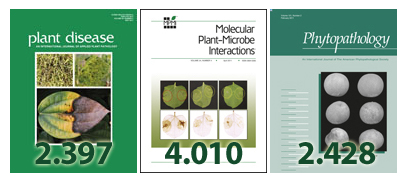
| Plant Disease Feature Article | |
In "Challenges and successes in managing oak wilt in the United States," Juzwik et al. review Ceratocyctis fagacearum and oak wilt. After discussing relative susceptibilities of oak groups, important features of C. fagacearum,  and the symptoms and epidemiology of oak wilt, the authors describe the challenges of implementing successful control measures for a landscape level disease with many stakeholders. The cost-sharing programs implemented in Texas and Minnesota could be a model for other diseases. Read more... and the symptoms and epidemiology of oak wilt, the authors describe the challenges of implementing successful control measures for a landscape level disease with many stakeholders. The cost-sharing programs implemented in Texas and Minnesota could be a model for other diseases. Read more... |
| Editors' Picks | |
Plant Disease Editor's Pick
Dr. R. Michael Davis, Editor-in-Chief
 Biochar soil amendments sequester carbon but how do they influence plant health? Read about the influence of biochar on soilborne diseases of asparagus in the August issue of Plant Disease. W. H. Elmer and J. J. Pignatello report that the addition of biochar to soil reduced the incidence of root lesions caused by Fusarium spp. but increased mycorrhizal colonization. In addition, some nutrients became more available and soil microbes were stimulated that favored beneficial fungi. Read more... Biochar soil amendments sequester carbon but how do they influence plant health? Read about the influence of biochar on soilborne diseases of asparagus in the August issue of Plant Disease. W. H. Elmer and J. J. Pignatello report that the addition of biochar to soil reduced the incidence of root lesions caused by Fusarium spp. but increased mycorrhizal colonization. In addition, some nutrients became more available and soil microbes were stimulated that favored beneficial fungi. Read more...
MPMI Editor's Pick
Dr. Gary Stacey, Editor-in-Chief
 The rhizobial-legume symbiosis is initiated by recognition of the lipo-chitin Nod factor (NF), which triggers a signaling cascade that involves protein phosphorylation. In the August issue of MPMI, Serna-Sanz et al. analyzed the Lotus phosphoproteome in response to NF addition, as well as to the bacterial elicitor, flagellin. The data suggest unique responses to NF but some overlap with pathways normally associated with the plant defense response. The data again raise the interesting question of how symbionts evade plant defenses. Read more... The rhizobial-legume symbiosis is initiated by recognition of the lipo-chitin Nod factor (NF), which triggers a signaling cascade that involves protein phosphorylation. In the August issue of MPMI, Serna-Sanz et al. analyzed the Lotus phosphoproteome in response to NF addition, as well as to the bacterial elicitor, flagellin. The data suggest unique responses to NF but some overlap with pathways normally associated with the plant defense response. The data again raise the interesting question of how symbionts evade plant defenses. Read more...
Phytopathology Editor's Pick
Dr. Niklaus Grunwald, Editor-in-Chief
 The bacterium Xylella fastidiosa causing Pierce's disease on grapevines is transmitted by an insect, the glassy-winged sharpshooter. Backus and Morgan elegantly determined how the bacterium persists inside the sharpshooter using a combination of confocal laser-scanning microscopy and GFP expressing X. fastidiosa. This work demonstrates that the bacterium does not persist in foreguts of the insect vector suggesting egestion from the sharpshooter as an inoculation mechanism. Read more... The bacterium Xylella fastidiosa causing Pierce's disease on grapevines is transmitted by an insect, the glassy-winged sharpshooter. Backus and Morgan elegantly determined how the bacterium persists inside the sharpshooter using a combination of confocal laser-scanning microscopy and GFP expressing X. fastidiosa. This work demonstrates that the bacterium does not persist in foreguts of the insect vector suggesting egestion from the sharpshooter as an inoculation mechanism. Read more... |